State & Territory / Influence & Narratives / Chris Minns / Protest rights
Whose voices count? Chris Minns's politics of control
Chris Minns thanked a pro-Israel community leader for his guidance and called a Palestine protest organiser a "professional dissident". Twice, courts found his government's protest restrictions went too far. The Premier owes an account of whose advice he weighs, and why.
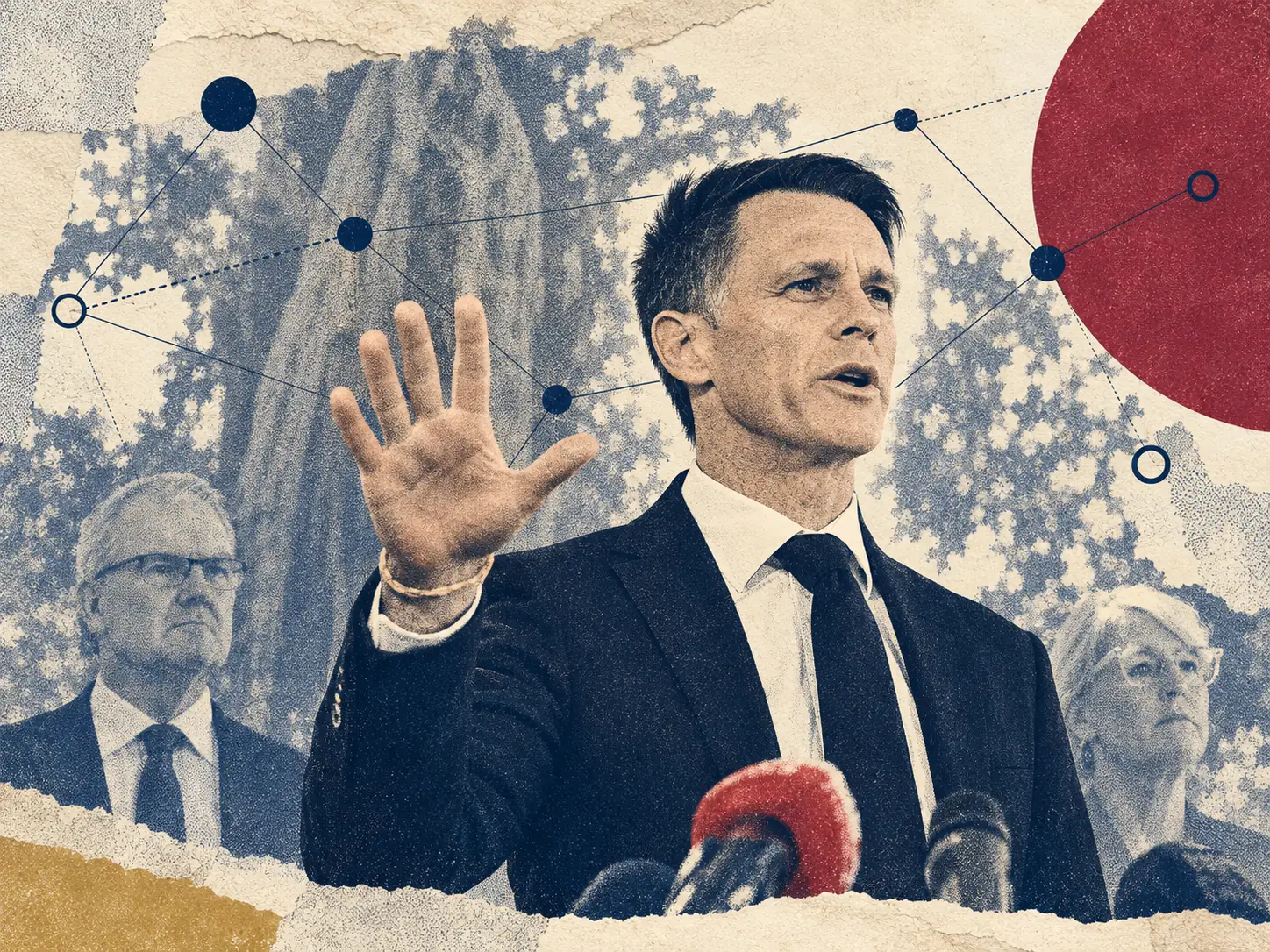
In February 2025, setting out his antisemitism and places-of-worship package, Chris Minns thanked NSW Jewish Board of Deputies president David Ossip for his "guidance and support". A year later, defending the policing of protests against Israeli President Isaac Herzog's visit, he called Palestine protest organiser Josh Lees a "professional dissident".[1][2]
One advocate was credited in Parliament for his guidance on legislation. The other was dismissed for persisting. That asymmetry is the core of Minns's politics of control. Some voices are given the authority of the Premier's office, and others are treated as a problem to be managed. Twice, the courts found that restrictions built on that approach went beyond constitutional limits.
A real threat, and laws that went too far
The government had real obligations. In his February 2025 statement, Minns described antisemitic graffiti, an arson attack on a childcare centre and families frightened for their children.[1] On 14 December 2025, a terrorist attack on a Chanukah celebration at Bondi Beach killed 15 people and injured 40.[3] Protection was urgent. The question is whether the restrictions were tied to the threat.
Twice, they were not. In October 2025, in Lees, the Supreme Court accepted that protecting worshippers was a legitimate aim. It struck down the original move-on power because the power was not confined to conduct affecting access to worship. The government's December replacement tightened that link, which shows a narrower rule was available all along.[4][5]
Five days after Bondi, the government announced a declaration scheme that blocked the ordinary routes for authorising assemblies in designated areas.[6] In April 2026, in Jarrett, the Court of Appeal found the challenged provisions imposed an unjustified burden on political communication. They burdened gatherings regardless of their purpose or their effect on social cohesion.[3]
Not every measure failed: a challenge to the major-event declaration for Herzog's visit was dismissed.[7] But the pattern is clear. Faced with fear, the government reached for breadth, and the courts had to supply the limits.
When organisers become the problem
Minns's rhetoric supplied the public rationale. On 23 December 2025, days after the attack, SBS reported him calling Lees's response to a proposed chant ban "almost troll-like". He also said some protesters were "unleashing forces that they can't control".[8] Nothing in those remarks showed any link between the protest movement and the terrorist attack.
Expression can intimidate Jewish Australians without causing violence, and the government was entitled to point to rising tensions and strain on police.[6] But a restriction must still be connected to the risk it addresses, and that connection is what Jarrett found missing. Once an organiser is cast as a source of danger, his demand drops out of view and the debate becomes how to contain him. The burden should run the other way. The government must justify the restriction; lawful protesters should not have to disprove a general suspicion.
The same reflex applied inside Labor. In May 2024, Minns removed Anthony D'Adam from his parliamentary secretary roles after D'Adam criticised the policing of a Palestine demonstration and refused to withdraw his comments.[9] Minns was later reported telling state MPs who advocated for Palestinians to focus on state issues or seek federal office.[10] A Premier chooses his team. His choice here was to defend the police and remove the critic.
It applied again after Herzog's visit. When footage of force at Town Hall circulated, Minns called the policing "proportionate and responsible" and Lees a "professional dissident", while denying he gave operational instructions.[2][11] The Law Enforcement Conduct Commission's investigation is ongoing, with no misconduct findings.[12] The legal verdict on police conduct can wait. The political verdict on a Premier who publicly defended it need not.
Organising protest again and again is a democratic contribution. Persistence should earn an answer to the argument, not become a reason to discount the person making it.
Not only Palestine
This is not a Palestine-only policy. Important parts of the NSW protest framework predate Minns, and his government's restrictions have also reached climate and rail protesters.[13][14] When police sought to prohibit the August 2025 Harbour Bridge march, the Supreme Court refused.[15] Minns governs by a broad law-and-order reflex.
That makes the question of standing sharper, not weaker. The powers apply to everyone. What differs is whose account of safety the Premier publicly credits, and whose dissent he treats as the problem.
Who has the Premier's ear
Ossip's input is on the record. Minns acknowledged it in Parliament for the February 2025 package, though not which clauses it shaped.[1] Ossip is a community safety advocate with a defined political position. In parliamentary evidence, he linked Jewish safety to Israeli sovereignty, while accepting that the Israeli government could be criticised.[16]
Steven Lowy appears in the Premier's diaries more often than any other individual in our comparison. He has had seven meetings between November 2023 and May 2026, three of them described as community relations and security (July, September and November 2025).[17][18][19][20][21][22] He is listed as a board member and trustee of Keren Hayesod–UIA and a member of the Jewish Agency's Executive and Board of Governors.[23]
One of those meetings, on 6 November 2025, came three weeks after the Lees judgment and 12 days before the replacement places-of-worship bill was introduced.[21][24] In a June 2026 royal commission statement, Lowy argued that authorities had failed to recognise an escalation of antisemitism through protest towards violence. That statement postdates the assembly scheme and does not mention these powers.[25]
Across 729 disclosed diary entries from 7 October 2023 to 14 June 2026, we identified 61 community and Israel-related meetings. Of these, 39 were with Israeli representatives, pro-Israel advocates, or Jewish communal, religious and Holocaust-related counterparts. The other 22 were with Palestinian, Muslim, interfaith or civic-cohesion counterparts.[26] The Premier has met APAN, the Lebanese Muslim Association and the Australian National Imams Council.[17][18][20][27] Access was not exclusive, but on this broad grouping it was uneven.
The diaries record who was in the room, not what was said. That is why Minns should answer three questions:
1. What was raised at his three meetings with Lowy on community relations and security?
2. Did protest or assembly powers come up on 6 November 2025?
3. What representations, in those meetings or outside them, informed the assembly scheme and the Herzog-visit measures?
Whose voices count
Consultation is legitimate, including with people who hold strong views about Israel. Communities facing threats deserve protection and a hearing. But a Premier who publicly credits some advocates, gives them regular access, and disparages persistent Palestine protest owes an account of how he weighs the two. People challenging Israeli policy deserve an answer to their arguments. They should not be made to carry responsibility for violence they have not been shown to cause.
Minns should release the advice, alternatives and reasons behind his restrictions, and explain why he gave this rhetoric the weight of his office. A democracy cannot make being agreeable to the Premier the price of being heard.
Evidence & approach
How this argument is tested
This essay compares official meeting disclosures, attributable statements, legislation and court decisions. Ministerial diaries disclose dates and broad purposes, not the content of advice or any contribution to particular restrictions. Meeting counts measure disclosed access, not lobbying or policy influence. The comparison covers 7 October 2023 to 14 June 2026 and a declared 61-row cohort. Its combined group of 39 includes 13 Jewish communal, religious or Holocaust-related entries whose political alignment is unclassified, and one shared Jewish/Muslim interfaith meeting, counted once. One Lowy entry concerns housing. The ongoing LECC investigation is distinguished from findings of misconduct.
The public record
Sources
Numbered in order of first citation. Each external link opens in a new tab to the original publisher’s document or an official reproduction; notes explain what it supports and its limits.
- Chris Minns · Parliamentary statement on antisemitism, 11 February 2025
Primary text acknowledging Ossip's guidance and describing the government's reasons for legislation. It also recognises Middle East debate and peace for Israeli and Palestinian children. No authorship of particular clauses is disclosed.
Return to citation ↑ - NSW Hansard · Israeli President Visit, 11 February 2026
Minns's parliamentary defence of policing, criticism of Lees and denial of operational instructions. The questioner's allegations and crowd estimate are not attributed to Minns. The source opens the Hansard document viewer.
Return to citation ↑ - NSW Court of Appeal · Jarrett v State of NSW [2026] NSWCA 62
16 April 2026 judgment invalidating the challenged PARD provisions. This is distinct from the places-of-worship law and the Herzog major-event challenge. It does not decide the legality of every arrest or use of force.
Return to citation ↑ - NSW Supreme Court · Lees v State of NSW [2025] NSWSC 1209
16 October 2025 judgment, especially paragraphs 112–161 and orders: original section 200(5) invalidated; protection of worshippers accepted as legitimate. Separate worship-access offences were not invalidated.
Return to citation ↑ - NSW legislation · Places of Worship amendment, Act 84 of 2025
Assented to and commenced on 3 December 2025. Replaced the invalid provision with section 200AA, expressly linked to conduct affecting people accessing or leaving worship and to directions to those engaging in it.
Return to citation ↑ - NSW Government · Proposed assembly restrictions after Bondi, 19 December 2025
Primary announcement of the proposed PARD scheme and the government's safety rationale. Its description of the scheme as proportionate is the government's assessment.
Return to citation ↑ - NSW Supreme Court · Lees v State of NSW [2026] NSWSC 58
Orders on 9 February, reasons on 11 February 2026. The challenge to the Herzog visit's major-event regulation/order was dismissed. PARD validity was not challenged in this proceeding.
Return to citation ↑ - Alexandra Koster / SBS · Minns's comments on protesters, 23 December 2025
Attributes the troll-like description to his response to Josh Lees and preserves his qualifications concerning some protests and organisers. His implied causal connection with extreme violence is not treated as an established fact.
Return to citation ↑ - ABC News · Minns removes D'Adam after criticism of policing, 16 May 2024
Documents removal from parliamentary secretary roles, Minns's stated reasons and D'Adam's defence of his speech. He retained his parliamentary seat; no general legal ban on criticism is claimed.
Return to citation ↑ - ABC News · Minns and the NSW Labor conference, 26 July 2024
Nick Dole's analysis recalls Minns telling state MPs advocating for Palestinians to focus on local issues or seek federal office. Used as attributed reporting, not a formal prohibition.
Return to citation ↑ - ABC News · Minns and police respond to Town Hall footage, 10 February 2026
Updated 20 February. Records official defence, footage of force, allegations and competing accounts. Arrest allegations and accounts of necessity are not convictions or independent findings.
Return to citation ↑ - LECC · Operation Makalu progress update, 15 September 2026
Latest official update checked on 19 September: investigation continues; procedural issues postpone public examinations beyond September. No final misconduct determination is established by the update.
Return to citation ↑ - NSW Parliamentary Research Service · Protest law in New South Wales
Explains the authorisation framework and 2022 protest legislation, which predated Minns's premiership. Used for the historical baseline, not as a statement of every current provision.
Return to citation ↑ - ABC News · Minns's broader protest-policy record, 12 February 2026
Alexander Lewis's analysis identifies restrictions affecting climate/rail protests as well as Palestine-related demonstrations. Used to test a single-cause account of the government's approach.
Return to citation ↑ - ABC News · Harbour Bridge march permitted after court challenge, 2 August 2025
Contemporary report of Rigg J refusing the police prohibition application. The march was scheduled for 3 August 2025.
Return to citation ↑ - NSW Parliament · David Ossip's evidence, 19 May 2025
Corrected transcript, printed pages 2 and 4. Ossip's account of protest and antisemitism, his defence of Israeli sovereignty and his acceptance of legitimate criticism are read together. These public statements do not disclose his advice to Minns or establish the origin of Minns's language.
Return to citation ↑ - NSW Premier · Ministerial diary, October–December 2023
Pages 1, 4 and 5 record separate ambassador and ECAJ/JBD meetings, Lowy/JBD co-attendance, and APAN access. Entries disclose dates and broad purposes, not detailed advice or outcomes.
Return to citation ↑ - NSW Premier · Ministerial diary, January–March 2024
Records Lowy, Israeli diplomatic and APAN/Muslim-community meetings. The presence of different counterparts does not establish equivalent input or exclusive access.
Return to citation ↑ - NSW Premier · Ministerial diary, October–December 2024
PDF page 8: 17 December meeting with Steven Lowy and Amplify concerning housing. This different stated purpose prevents all contacts being treated as Israel-related lobbying.
Return to citation ↑ - NSW Premier · Ministerial diary, July–September 2025
PDF pages 1 and 4: Steven Lowy meetings on 3 July and 18 September, both described as community relations and security. PDF page 2 also records the Lebanese Muslim Association meeting on 24 July, concerning multicultural and interfaith matters.
Return to citation ↑ - NSW Premier · Ministerial diary, October–December 2025
PDF page 3: 6 November meeting with Steven Lowy concerning community relations and security. This establishes access, not authorship of restrictions.
Return to citation ↑ - NSW Premier · Ministerial diary, April–June 2026
PDF page 2: 21 May meeting with Steven Lowy, described as community matters. PDF page 3 records Sheikh Shadi on 28 May, concerning community cohesion.
Return to citation ↑ - Keren Hayesod–UIA · Steven Lowy governance profile
Current-listed board/trustee and Jewish Agency roles, checked September 2026. This does not establish the capacity in which Lowy attended a Premier meeting.
Return to citation ↑ - NSW Parliament · Replacement Places of Worship bill, 18 November 2025
Legislative Assembly introduction on 18 November 2025. Proximity to a meeting establishes chronology, not representations or policy influence.
Return to citation ↑ - Royal Commission · Steven Lowy witness statement, 25 June 2026
Exhibited 29 June, Exhibit 3-031. Attributed threat/protest assessments and security recommendations are Lowy's views, not Commission findings. The statement postdates PARD and *Jarrett* and does not disclose a request to Minns for the specified NSW assembly powers.
Return to citation ↑ - The Alderwick Institute · Premier diary comparison and method (official disclosure index)
Our audit of 11 quarterly Premier PDFs, Q4 2023–Q2 2026, reviewed 729 entries within 7 October 2023–14 June 2026 and selected a declared 61-row community/Israel-related cohort. Combined group: 39, comprising 26 documented pro-Israel-present entries plus 13 other Jewish communal, religious or Holocaust-related entries with unclassified political alignment, including Ernie Friedlander (25 November 2025, Q4 PDF p.4). Other relevant community: 22 (17 Palestinian/Muslim and five interfaith/civic). One combined-group row is the shared JBD/Muslim meeting of 1 October 2024. Each disclosed row counts once. Lowy appears seven times and Ossip twice; a Lowy entry concerns housing. The linked government page is a disclosure index, not an official endorsement of our classifications or counts. Full ledger and calculation preserved in community-access comparison v003. Counts are not proof of lobbying or policy influence.
Return to citation ↑ - NSW Premier · Ministerial diary, January–March 2026
Pages 1–2 and 5. The 16 February meeting with the Lebanese Muslim Association, Australian National Imams Council and Minister Dib concerned February protests. Other entries concern the Bondi attack.
Return to citation ↑
Right of reply
None received as at .
A response from Chris Minns was requested by .
People and organisations discussed in this article can submit a response. Material corrections and relevant responses will be recorded here, with dates and an explanation of any change to the argument.
Continue the research
Connected questions
When does fighting antisemitism restrict legitimate criticism of Israel?
Examine how definitions and institutional policy can restrict debate.

How defending Israel can shield its radical right
Place Australian political rhetoric in the wider argument.